Image
Quarter of Earth in green tint showing network connections

A new PNAS Nexus study from the Biocomplexity Institute introduces a scenario-aware AI framework that helps stop complex spread processes before they escalate, from agricultural pests to pandemics.

Image
chalkboard drawing of gears

The University of Virginia has launched a new Research Hubs initiative to strengthen interdisciplinary collaboration and accelerate discovery. The Biocomplexity Institute will lead two hubs focused on Integrated Energy Systems & Communities and Supply Chains & Critical Materials, bringing together researchers across UVA to address complex, real-world challenges.

Image
Blue virus mutating into red virus

A new study published in Proceedings of the National Academy of Sciences (PNAS) introduces an integrated modeling framework that connects epidemic dynamics, genomic surveillance, and population immunity, offering a powerful new approach to understanding how emerging variants shape pandemics.

Image
Overhead view of shipping dock with containers

Where are critical mineral supply chains most fragile? AI-driven research from UVA’s Biocomplexity Institute uncovers the hidden dependencies shaping global risk.

Image
People on train

What if we could predict the flu before it hits? UVA’s Biocomplexity Institute is doing just that—with cutting-edge AI tools designed to give communities time to prepare.

Image
overhead view of farm fields

Four recent research papers from the University of Virginia’s Biocomplexity Institute are making waves in the field of artificial intelligence and remote sensing, with a focus on sustainable agriculture and water resource management.

Image
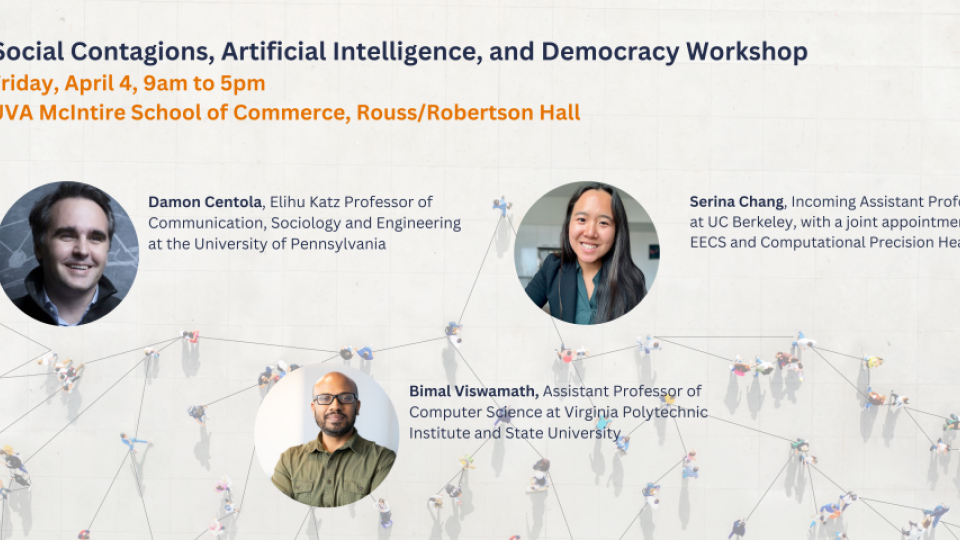
Picture of keynote speakers

The Social Contagions, Artificial Intelligence, and Democracy workshop brings together scholars to explore how social contagions can be used to understand how AI and related digital technologies may challenge or, potentially, fortify democratic institutions and practices.

Image
Virginia Academy of Science, Engineering and Medicine Conference

The Biocomplexity Institute at the University of Virginia (UVA) showcased its work at the 2024 Virginia Academy of Science, Engineering, and Medicine (VASEM) Energy Summit, held October 28-29, 2024. The summit, which brought together leaders in energy research, policy, and education, provided a platform for UVA researchers to present cutting-edge developments in energy systems and artificial intelligence.

Image
network of lights

Research Associate Professor Bryan Lewis Featured at NASEM Workshop

Image
medications coming out of a bottle

According to the Centers for Disease Control and Prevention (CDC), more than 63,600 people died from opioid overdoses in the United States in 2016, and more than 70,000 people died from the same cause in 2017. The opioid epidemic in the United States is showing no signs of abating, but researchers from the Biocomplexity Institute have identified potential geographic opioid misuse and abuse hotspots in Virginia, West Virginia, and North Carolina using network scan statistics – a methodology that may ultimately be used to save lives through targeted interventions in high-risk areas.

Image
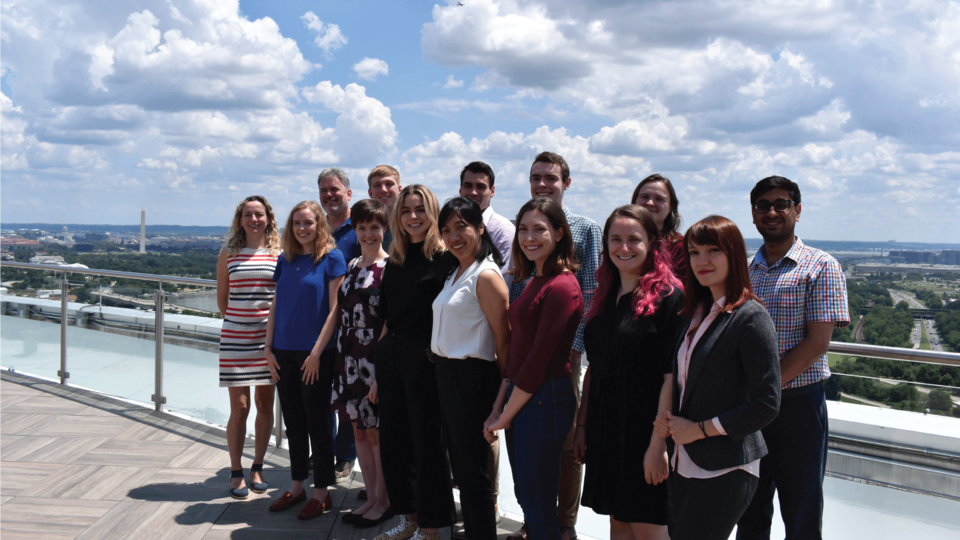
DSPG students

Have you ever wondered what a career combining data science and public service looks like? This summer, 12 undergraduate and graduate students from across the country convened at the Biocomplexity Institute's Arlington, Va. location to find out first-hand.

Image
woman in mask in crowd

While vaccination is the primary and most effective way to prevent sickness and death caused by flu, the CDC reports that less than 40 percent of Americans age 18 and older typically receive a flu shot. This begs the question: what additional mitigation and prevention methods might improve the public health response and policy development for the flu? 

Image
S.S. Ravi

The use of artificial intelligence (AI) is everywhere. From making diagnoses in the medical profession to determining sentencing in court cases, we are increasingly relying on AI and machine learning algorithms to make decisions that can have a profound impact on people’s lives. As the use of AI becomes even more prevalent, how do we know that the algorithms and models used to make these critical decisions are correct, unbiased, and reliable?

Image
farmscape

From local neighborhoods and schools to courtrooms, hospitals, fields, and forests, data are everywhere, providing us the power to solve problems like never before. Communities large and small now have access to a wealth of data they can use to assess conditions, develop strategies and policies, evaluate impact, and make critical decisions. However, not all communities – particularly those that are small or rural – have the expertise or resources necessary to access and leverage complex data for real-world benefits.

Image
cherry tomatoes

Agricultural trade is crucial in delivering food to consumers worldwide. The benefits range from lower prices to greater variety in our food supply, and most importantly, the ability to reduce food insecurity across the globe. But, as international trade increases, so does the spread of invasive and destructive agricultural pests that can threaten food production and even destabilize our global food supply. 

Image
fountains of lines and data

The University of Virginia’s Biocomplexity Institute was recently awarded a five-year $4 million collaborative grant from the U.S. National Science Foundation (NSF) to build a self-sustaining cyberinfrastructure (CINES – pronounced “science”) to serve as an open-source, web-based repository for developing, trading, analyzing, and sharing network science resources. 

Image
beachball earth deflated by COVID punctures

The many unknowns about COVID-19 – including its precise origin, how long the disease incubates, and when during the incubation people become contagious – have made data collection, and therefore, identification of effective intervention methods challenging. In response to this global pandemic, researchers from the University of Virginia’s Biocomplexity Institute have developed a set of visualization and analytical web applications to help provide a better understanding of the epidemic’s scope and aid in bringing the outbreak to a swift conclusion.

Image
COVID in the body

The 2019 Novel Coronavirus (COVID-19), which originated in Wuhan, China, in late 2019, has received significant global attention due to the rapid speed and widespread reach of the outbreak. As of early March 2020, COVID-19 has exceeded 92,000 confirmed cases in 76 countries within a span of two months.

Image
COVID-19 in hexagons

As the COVID-19 global health crisis continues to unfurl worldwide, the questions around global pandemics are no longer “if” they will occur, but how frequent, widespread, and severe those that come next will become.

Image
colorful vegetables

In 1969, then-President Richard Nixon commissioned the first and only White House Conference on Food, Nutrition, and Health, which became a catalyst for much-needed progress in U.S. policy focused on hunger and malnutrition. What was set in motion over the course of the three-day conference changed the national landscape around food and nutrition policy, and has had lasting impact almost five decades years later.

Image
Welcome to Virginia

Governor Ralph Northam, in partnership with researchers from the University of Virginia’s Biocomplexity Institute and the nonprofit RAND Corporation, released new infectious disease modeling on the impact of COVID-19 mitigations in Virginia.

Image
COVID_surveillance_dashboard

The University of Virginia’s Biocomplexity Institute has released an enhanced version of its popular COVID-19 Surveillance Dashboard with new features including county-level data for the United States and state/province-level data for 15 other countries.

Image
medical demand dashboard

Will our hospitals have the capacity to care for those who become infected? This question remains at the heart of COVID-19 planning and response discussions everywhere as public health officials and policy makers consider how lifting interventions such as stay-at-home orders will impact a potential resurgence of the disease.

Image
Srini on Zoom

Researchers have developed a model that uses social-media and search data to forecast outbreaks of Covid-19 well before they occur.

Image
young woman putting on mask

As the COVID-19 pandemic continues to escalate in the United States and in many locations around the world, countless questions remain about next steps for mitigation and response. How will various mitigation methods affect the spread? How will those change as the pandemic progresses or regresses?

Image
hipster macbook surrounded by plant, notebook, pen, glasses, and phone

A research team across three states is seizing the opportunity to share their aspiration to create a data-driven National Community Learning Network to support economic mobility.

Image
hospital beds in a warehouse

New tool provides projections of critical data on bed capacity and hospitalization rates.

Image
hands planting a tree with a transparent globe over them

Researchers at the University of Virginia Biocomplexity Institute are founding partners of a national research institute that will develop artificial intelligence-driven solutions for some of agriculture’s biggest problems: labor, water, weather, and climate change.

Image
planet with dots and binary

This year, an unprecedented number of speakers from the Biocomplexity Institute’s Social and Decision Analytics division were part of the 2021 Joint Statistical Meetings. Topics ranged from broadband challenges in rural communities to career pathways for Army veterans.

Image
Chris Kuhlman, Dustin Machi and S.S. Ravi

What do hip-hop and hurricane evacuations have to do with network science? High school students learned the answers to that and more in an inaugural series of network science lectures, given by University of Virginia Biocomplexity Institute researchers Chris Kuhlman, Dustin Machi and S.S. Ravi at the annual Achievable Dream Summer Program.

Image
hand interacting with a network of red dots

Rather than a shut-down, what if we knew which places to close during a pandemic to curtail the spread of a virus and lessen the economic impact to a locality? A model showing how this can be done, created by researchers at the University of Virginia Biocomplexity Institute and Stanford and Northwestern universities, has won a Best Paper Award in the Applied Research track at the recently concluded ACM KDD conference.

Image
map of waterways from above

Washington, DC, metro-area stakeholders will soon have a new tool at their fingertips to inform equitable and sustainable growth, a critical issue for a region where more than 5.5 million people now live and strong growth is expected over the next 25 years. The unique data platform will emerge from the University of Virginia Biocomplexity Institute’s launch of a Social Impact Data Commons, an open curated knowledge repository that will co-locate data from various sources, including public datasets, administrative records, and private sources focused on the region.

Image
Madhav Marathe black and white profile

Researchers from UVA’s Biocomplexity Institute and School of Engineering and Applied Science, working with a team of multi-disciplinary scientists from around the world, have spent the last two years developing highly advanced computational models designed to inform policy makers, save lives and prepare for future global epidemics.

Image
globe with lights behind

Contagions, severe weather, natural disasters, civil unrest – whatever data scientists are forecasting using network models, simulation-based methods are often the most effective, according to researchers at the University of Virginia Biocomplexity Institute and Princeton University, whose findings were published in the paper, “Fundamental Limitations on Efficiently Forecasting Certain Epidemic Measures in Network Models,” by PNAS (Proceedings of the National Academy of Sciences).

Image
people in network from above

A research team at the University of Virginia has set its sights on developing new and better measures of America’s people, places, and the economy through a comprehensive innovation they call a Curated Data Enterprise. The research is being done in collaboration between the U.S. Census Bureau and UVA’s Biocomplexity Institute with additional support from the Alfred P. Sloan Foundation.

Image
bacteria

The Bacterial and Viral Bioinformatics Resource Center (BV-BRC), a beta website that launched in February, “is one-stop shopping for your bacterial or viral genomic research,” said Ron Kenyon, a senior scientist in the Network Systems Science and Advanced Computing division of UVA’s Biocomplexity Institute.

Image
man wearing cloth mask in front of a skyscraper

Paper published in PNAS outlines a multi-contagion framework that intertwines a threshold social contagion model with an epidemic model to investigate the interrelated dynamics between mask-wearing and disease.

Image
Contagion Science Network Connections

In alignment with the University of Virginia’s goal to move its research from prominence to preeminence, deans, faculty, and researchers from across Grounds got together to participate in the formal launch of the Contagion Science program, an initiative funded by the University as part of its Prominence-to-Preeminence STEM initiative.

Image
female and male scientists looking at a large monitor

Infectious pathogens in bacteria, viruses, fungi, and parasites naturally evolve over time. As they do, they can develop antimicrobial resistance (AMR) to available medicines. When this happens, antibiotics and other antimicrobial medicines lose efficacy and these infections become more difficult to treat, increasing the likelihood of disease spread, severity, and death.

Image
hands typing at keyboard

In an area where the doctor-to-patient ratio for primary care physicians is one to every 3,500 people and the only hospital closed in 2017, officials grappled with how to ensure Patrick County families had proper health care services when they needed them.