
AI for Science: ORNL and Universities Come Together to Advance Scientific Discovery
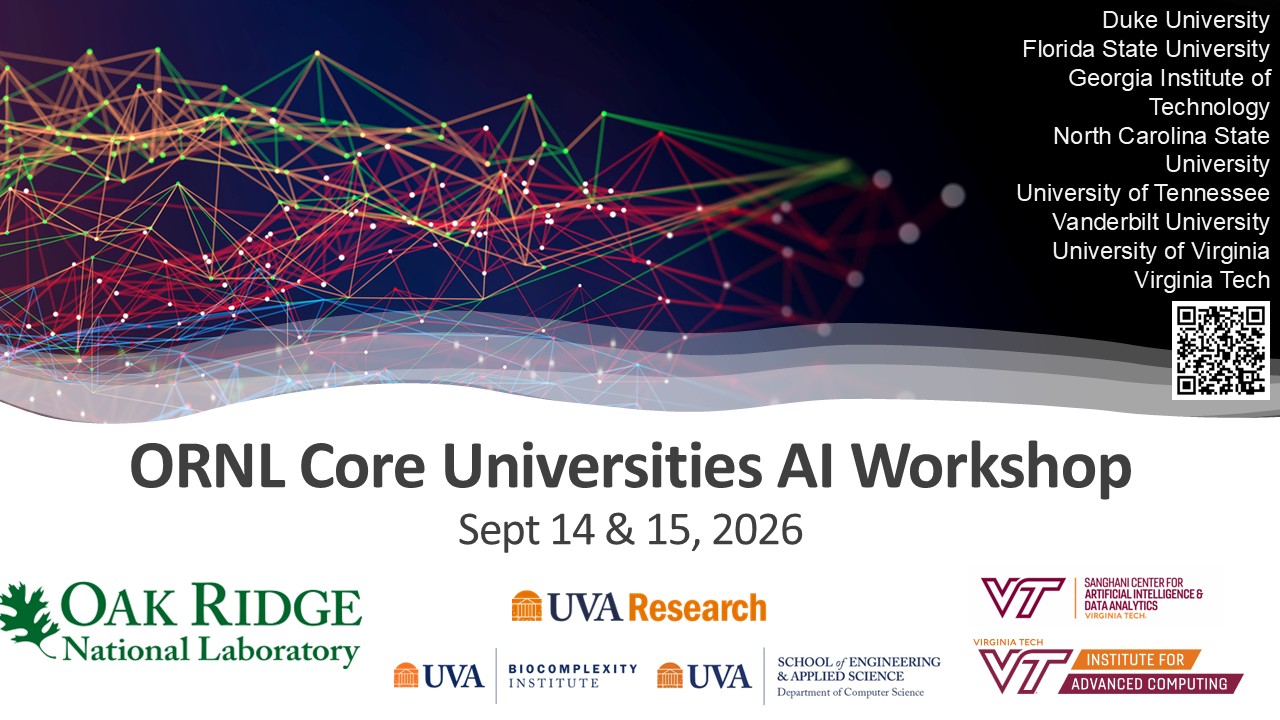
Researchers from Oak Ridge National Laboratory (ORNL) and leading universities gathered in Charlottesville on September 14–15 for the 2026 ORNL AI Core Universities Workshop, a two-day meeting focused on the rapidly evolving role of artificial intelligence in science and scientific discovery.
Hosted at the Boar’s Head Resort, the invitation-only workshop brought together researchers from ORNL and its core university partners. The goal was not only to showcase new research, but also to create connections across institutions and identify opportunities for collaboration.
The 2026 workshop was hosted in Charlottesville with support from ORNL, UVA Research, the UVA Biocomplexity Institute and Contagion Science Program, UVA Department of Computer Science, and Virginia Tech.
Day 1: Big Questions for AI and Science
Across two days of keynotes, research talks, panels, and informal discussions, participants considered both the opportunities created by AI and the questions that come with its growing role in scientific research. How can AI help researchers move more quickly from data to discovery? Where can AI agents contribute to scientific workflows? How should scientists evaluate uncertainty and maintain human judgment as increasingly capable AI systems enter the research process? And how can universities and national laboratories work together to ensure that new AI capabilities address important scientific problems?
The workshop opened with remarks from Thomas Potok of ORNL, Lori McMahon of UVA, and Naren Ramakrishnan of Virginia Tech, reflecting the collaborative partnership behind the 2026 meeting. The opening remarks were followed by a keynote from Georgia Tourassi of ORNL, who highlighted the motivation behind the Department of Energy’s Genesis Mission and its significance for the research community.
The second keynote of the day, delivered by Ryan Wright of UVA, AI Agents, Guardrails, and the Pace of Scientific Discovery, examined the implications of increasingly capable AI agents for research. Prof. Wright highlighted the severe implications of recent AI-initiated security breaches and raised important questions regarding the accountability of leading AI developers.
Day 2: From Algorithms to the Infrastructure of AI
Day two broadened the conversation to include the physical and computational infrastructure needed to support AI at scale. Kirk Cameron of Virginia Tech delivered the keynote Power-Aware Computing in the Age of AI, highlighting the growing importance of energy and computing resources as AI systems become more powerful. In the same vein, the question of computing infrastructure ownership, responsibility, and accountability was raised.
Throughout the meeting, discussions repeatedly returned to a larger question: What should the future relationship between AI and scientific discovery look like?
Joining Forces on Behalf of Academia: Universities and National Laboratories
The workshop also highlighted the importance of closer collaboration between universities and national laboratories at a time when advances in AI are changing both the tools available to scientists and the questions researchers can realistically tackle. The ORNL Core Universities network creates a venue for connecting those strengths.
The research environment is increasingly being shaped by industry, underscoring the need for universities and national laboratories to think beyond individual projects and consider the next generation of scientific challenges: Which problems should the research community begin preparing for today? What infrastructure will those problems require? Which partnerships can move scientific advances beyond individual laboratories and make them useful to the broader research community and the public?
These conversations underscored the complementary strengths of national laboratories and universities. ORNL brings major scientific facilities, computing resources, and multidisciplinary research programs, while universities contribute broad disciplinary expertise, students, new ideas, and research communities capable of exploring emerging questions.
For UVA, hosting the 2026 workshop also provided an opportunity to bring researchers from across the University into direct conversation with colleagues at ORNL and peer institutions. Over two days, formal presentations, panels, posters, meals, and informal conversations created opportunities for researchers to identify shared interests and begin conversations that can continue well beyond the workshop. As AI becomes increasingly integrated into scientific research, those connections may prove just as important as the technologies themselves.
54 Posters—and New Connections
One of the largest components of the workshop was its poster session, where 54 research posters created a forum for faculty, students, postdoctoral researchers, and laboratory scientists to exchange ideas and find new collaborators.
The scale of the session reflected one of the workshop’s central purposes: bringing together researchers who might otherwise work in separate disciplines or institutions and giving them time to talk about work in progress, compare approaches, and identify areas where expertise could be combined. The result was a meeting designed as much around building relationships as presenting research.